
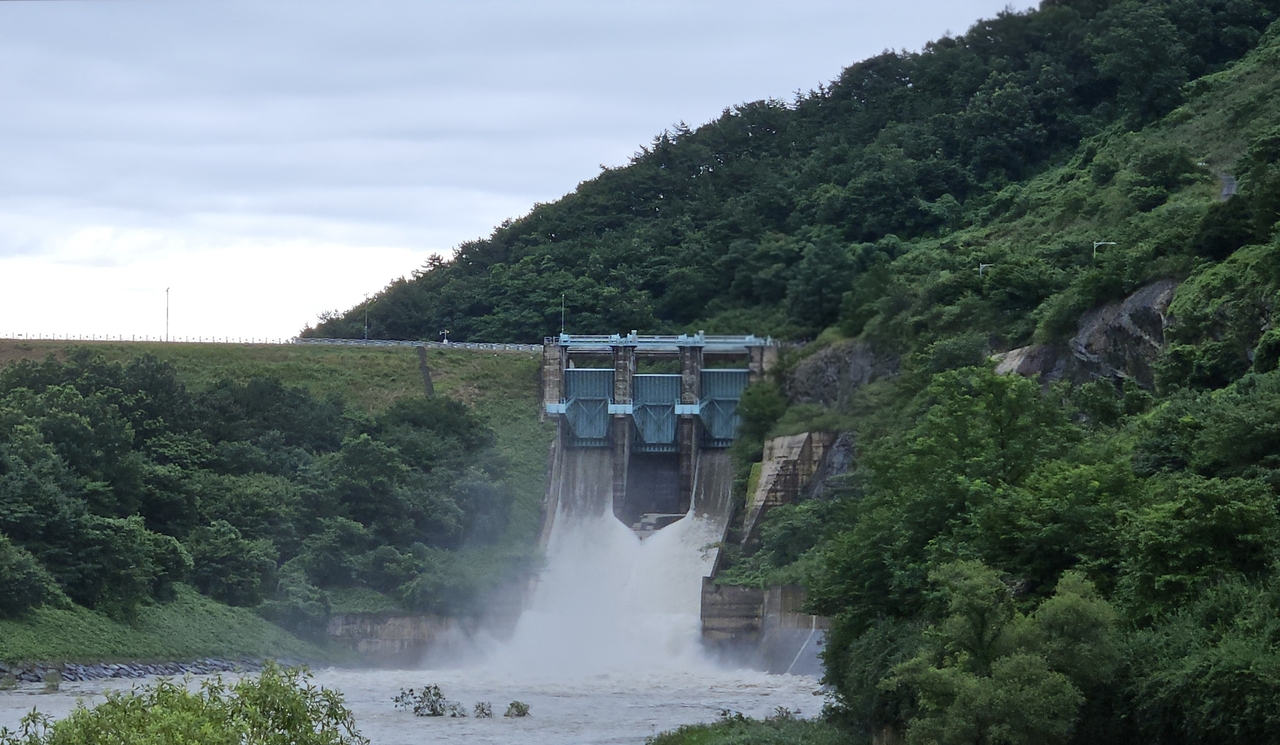
The Korea Water Resources Corp. (K-water) said Wednesday that it managed to mitigate downstream flooding despite rainfall exceeding dam design capacities in some regions after last week's record-breaking downpours.
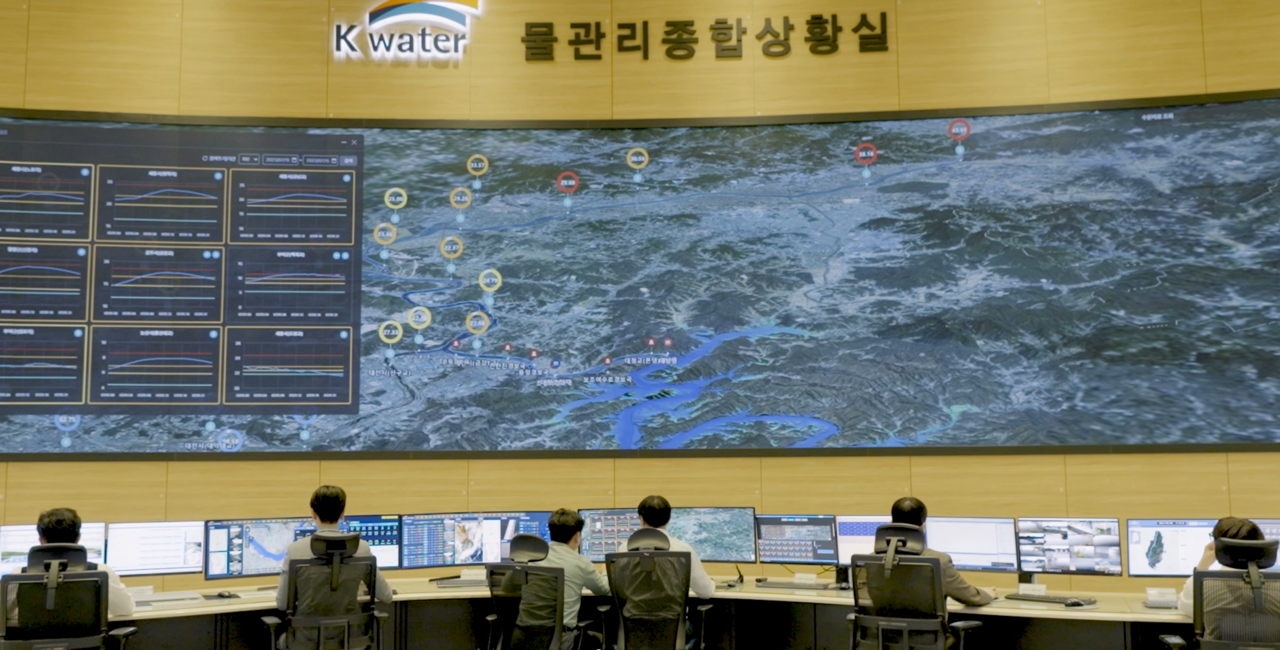
Together with weather forecasts, this was achieved by securing additional water storage capacity and capitalizing on technologies, such as digital twins, in response to the torrential rain, according to K-water. A digital twin is a virtual, dynamic model of a real-world dam and its surrounding environment, created by integrating real-time data from sensors and other sources installed on the actual dam.
As of 7 a.m., Sunday, only two dams — the Namgang Dam and the Boryeong Dam — had partially opened their spillways, while the remaining 18 retained all incoming water without any floodgate discharge, K-water added. This included key dam facilities in rain-hit regions in the North and South Chungcheong provinces and the southern region, such as Yongdam Dam, Daecheong Dam, Juam Dam, Hapcheon Dam and Miryang Dam.
Namgang Dam, located in Jinju, South Gyeongsang Province, saw cumulative rainfall of up to 529 millimeters for four days from July 16. On July 19 in particular, the dam saw hourly rainfall of up to 25 mm for more than six consecutive hours from 8 a.m. At its peak, the dam faced a historic inflow of 16,951 cubic meters per second — 1.6 times its maximum threshold — raising the water levels by 7.5 meters in six hours and leaving just 27 centimeters before reaching its maximum flood control level.
Despite the extreme inflow, the dam released only 22 percent of its water at the time, retaining the rest.
“Spill volumes were adjusted in real-time using a digital twin system that visualized flood risk zones in downstream areas,” K-water added. “Its actual discharge remained below the dam’s design limit of 3,750 cubic meters per second.”
Boryeong Dam in Boryeong, South Chungcheong Province, saw over 383 mm of collective rainfall. At 2 a.m. on July 17, 1,030 cubic meters of water per second flowed into the dam. However, it managed to hold out for 13 hours without releasing water through its sluice gates. Instead, collected water began to be released from 3 p.m. on July 17 until midnight on July 20.
Juam Dam in Suncheon, South Jeolla Province, also experienced a peak inflow of rainwater — over 2,430 cubic meters per second — as it saw heavy collective rainfall of up to 387 mm. Officials at K-water stated that it, too, retained all incoming water without discharge, prioritizing downstream safety.
Ahead of Korea’s rainy season, expected to last from June 21 to Sept. 20, K-water said it secured 6.84 billion cubic meters of reservoir capacity — more than triple the original design capacity of 2.18 billion cubic meters — by forecasting weather conditions and adjusting dam levels.
“This was done to anticipate and address the impacts of recent climate changes on dams built decades ago,” K-water added. As of 7 a.m., Monday, the 20 multipurpose dams had secured a flood control capacity of 5.1 billion cubic meters.
“In preparation for unprecedented complex disasters, (K-water) focused on securing sufficient water storage for multi-purpose dams and implementing proactive measures, including digital twins,” said a K-water official.
“Based on these preparations, we were able to effectively manage the dam water levels and store floodwaters during the heavy rainfall. We will continue to operate the dams scientifically and precisely to ensure public safety.”
lee.jungjoo@heraldcorp.com