
Ruling party aims to table pro-labor bill in plenary session Monday
The ruling Democratic Party of Korea on Sunday reaffirmed its intention to unilaterally push forward a pro-labor bill — dubbed the “Yellow Envelope Law” — through a plenary session scheduled for Monday, with the People Power Party vowing to launch a filibuster to block its passage.
Labeling the bill — which would revise Articles 2 and 3 of the Labor Union Act — as “corporate-killing legislation,” the People Power Party has hinted at delaying its passage for 24 hours through an unlimited debate during Monday’s plenary session. If a filibuster does take place, it will be the first in a plenary session in over a year.
However, even if the main opposition party attempts to block the passage of the bill through a filibuster, five liberal parties, including the Democratic Party, the Rebuilding Korea Party and the Progressive Party, hold a combined 185 seats at the National Assembly, enough to pass the 179-vote threshold to end the debate 24 hours after it kicks off.
Once the bill is put to a vote, the Democratic Party, which solely holds a majority of seats in the National Assembly, would have sufficient legislative power to pass the bill.
On Sunday, senior spokesperson of the People Power Party Rep. Park Sung-hoon said in a statement that the party would confront the liberal parties' "irresponsible, populist" legislation by "using all available measures it can, including the filibuster."
Park also described the proposed legislation as “essentially a ‘pro-illegal strike’ law and a ‘national industrial paralysis’ law.”
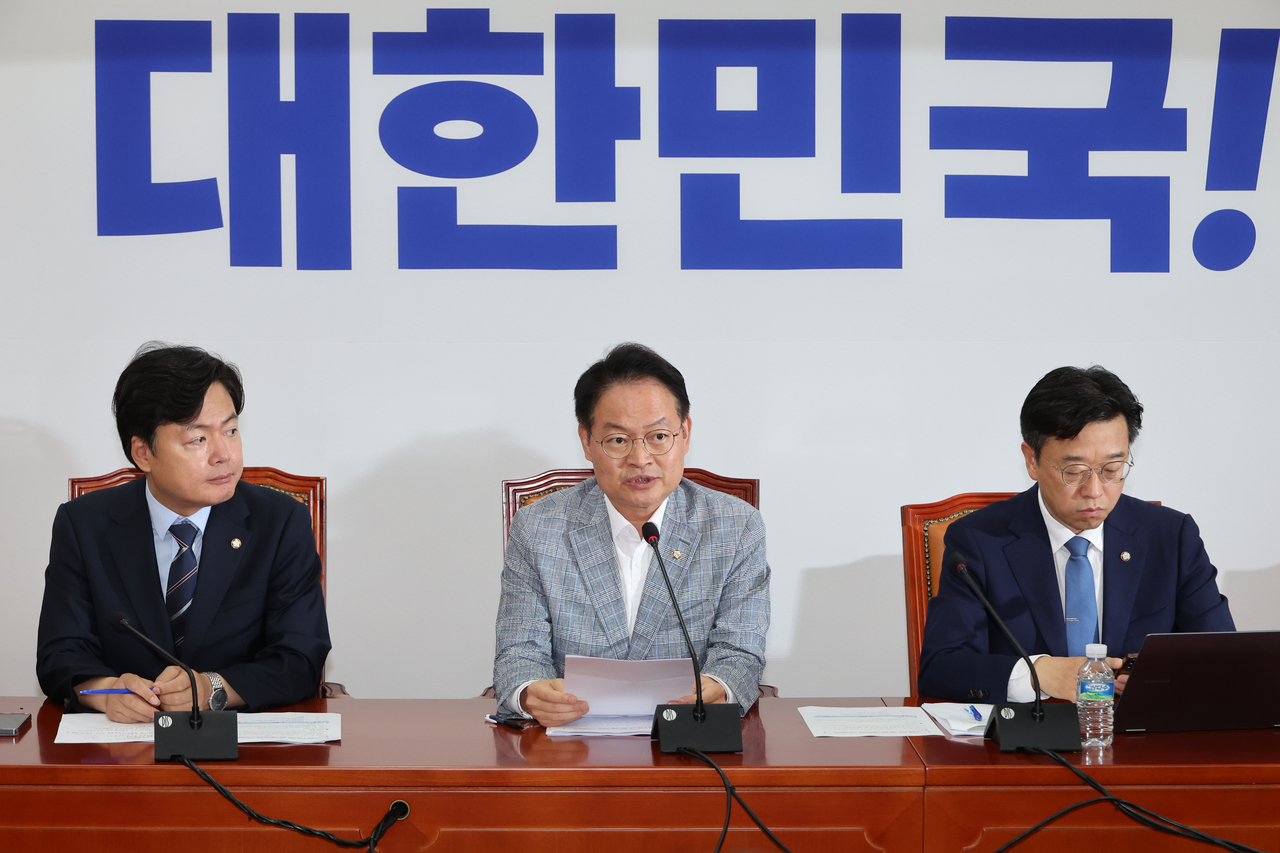
This came as Rep. Huh Young of the Democratic Party said during a press briefing on Sunday that the party would make it a priority to pass the controversial bill.
“As members of the floor leadership, we are determined to see this bill passed during this plenary session,” said Huh. “This legislation is aimed at breaking the vicious cycle of conflict and evasion of responsibility in labor relations by clearly defining the actual employer in subcontracting structures.”
One key feature of this bill is that it broadens the legal definition of the term “employer.” Under the amendments, any entity that “substantially and specifically controls and determines working conditions” would be considered an employer ― not just those who employ workers directly.
Another important feature of the bill is that it also expands on the definition of what constitutes a “legitimate labor dispute.” While labor disputes are legally limited to disagreements on “working conditions,” the proposed revision would broaden this to include “business management decisions that affect working conditions," meaning unions could legally strike not only over layoffs, but also over choices made by management such as investment plans.
Adding that the Yellow Envelope Law reflects standards including ILO recommendations, EU trade requirements and precedents from South Korea’s own Supreme Court, Huh said. “Ensuring labor rights is now recognized globally as the foundation of a stable and sustainable investment environment.”
Meanwhile, the Yellow Envelope Law passed during a session of the National Assembly’s Legislative and Judiciary Committee on Friday without bipartisan agreement.
After the bill was introduced, Democratic Party lawmakers of the committee proceeded to advance the bill to the plenary session, despite opposing remarks and requests for an opportunity to debate from committee members of the People Power Party.
Other than the Yellow Envelope Law, the Democratic Party also announced that it will work to push forward three broadcasting reform bills aiming to make public broadcasters more independent from political influence as well as an amendment to the Commercial Act that expands the fiduciary duty of board members to protect the interests of minority shareholders.
lee.jungjoo@heraldcorp.com